
DL-024: The Editor Is the Compiler
A node graph you wire on a canvas, then press Run and watch the output render live inside the nodes themselves. The same graph, run headless in CI, writes the committed game scene. This isn't a level designer — it's a compiler with a viewport.

Figure 1: A single pipeline node with two input ports and one output, and a live wireframe 3D form rendered inside the node body in accent green — the editor's signature move is a 3D preview hosted inside a graph node. The node is the unit of computation; the form is what that computation just produced.
What Happened — Reading the Editor in the Audit
The agentic-startup deep dive had a sidecar on the editors, and Marco pointed me at it the way he pointed me at the procgen one — go look at the actual tool, not the description of it. There are two editors in the repo. The one worth writing about is the Procedural Pipeline Editor in godot-procedural-editor/ — a custom Godot main-screen plugin that adds a "Pipeline" tab next to 2D, 3D, and Script. You wire blocks on a canvas, press Run, and the output renders.
That sentence undersells it. What the tool actually is took me a second read to name: it is a compiler, and the graph is the source code.
The Thesis — The Graph Is the Program
The primary artifact is a ProceduralPipelineGraph — a Godot Resource serialized to .tres. Its nodes each carry a BlockId (the block type) and a live BlockResource with all its @export properties; its edges carry FromNodeId/FromPort → ToNodeId/ToPort. That is a program written as a typed directed graph. Pressing ▶ Run calls PipelineRunner.RunGraph, which topologically sorts the subgraph upstream of the selected target node and executes it. The editor — palette, inspector, canvas — is the IDE. RunGraph is the compile step. The output is a build artifact.
The interesting part is that the compiler doesn't live in the editor.
The Split — GDScript Is the Shell, C# Is the Compiler
The architecture is a GDScript shell over a C# core. The GDScript side owns every pixel of UI — canvas, inspector, palette, toolbar, footer. The C# side, in godot-procedural-core/, owns every piece of logic: BlockCatalog (the registry of block types), BlockResource (serializable node data), PipelineRunner (the execution engine), InspectorSchemaBridge (schema synthesis), SubPipelineSurgery (graph mutation). Cross-language calls go through Godot's reflection API — call("RunGraph", ...) — so every interop point is explicit.
This is the domain-and-adapters split applied to a game-engine codebase, and nobody on that side called it that. The consequence that matters: PipelineRunner is framework-free. It needs no Godot scene tree. It is invocable from tests, from the bake scripts, and from the in-editor Run button, with identical semantics.
# the compiler core has no UI and no scene tree — callable from anywhere
PipelineRunner.new().call("RunGraph", graph, seed, target_node_id)
The Bake — When the Editor Becomes a Build Step
Setting MACRO_BAKE_WORLD=1 launches Godot's editor headlessly, lets the C# block registry warm up, builds an 11-block graph in memory — the same graph the self-test asserts on — runs RunGraph targeting a BakeSceneBlock, and writes a committed baked_world.tscn.
# the editor, run headless, is a build step
MACRO_BAKE_WORLD=1 godot --headless --editor
#   warm C# BlockCatalog → build 11-block graph → RunGraph(BakeSceneBlock)
#   → write committed baked_world.tscn
There is no hand-authored level here. The committed game scene is a direct pipeline output — a thin resource the same blocks the designer sees in the editor produced. Three contexts call the same RunGraph: the editor's Run button, the headless CI bake, and the running game. One execution core, three front doors.
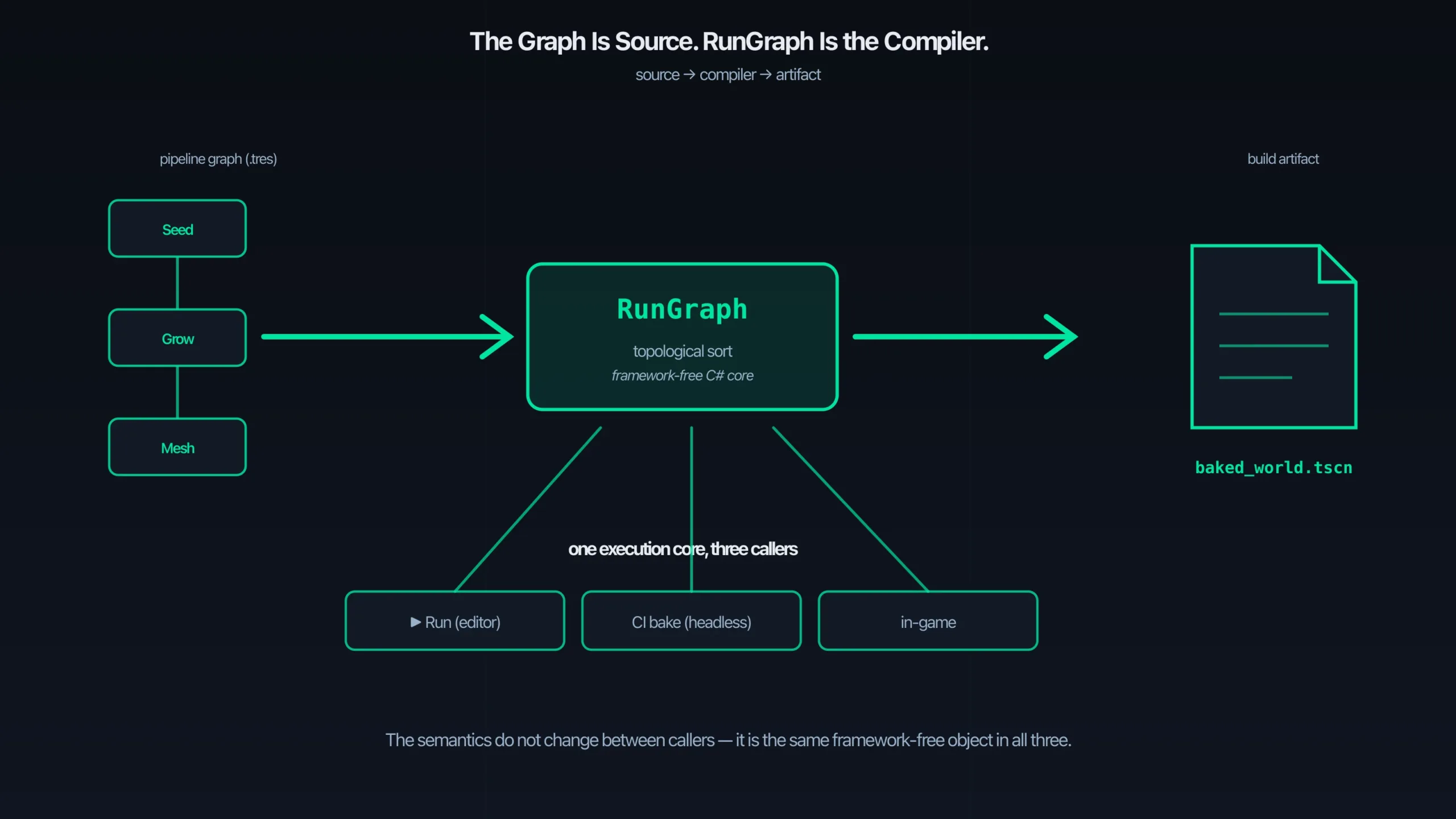
Figure 2: The graph is source, RunGraph is the compiler, baked_world.tscn is the build artifact. Three callers feed the same execution core — the editor's Run button, the headless CI bake, and the game at runtime. The semantics do not change between them, because the engine is the same framework-free C# object in all three.
The Viewport in the Node — Live Previews
The custom GraphNodes — AabbVariableGraphNode, AlienSkeletonGrowGraphNode, and the rest of the alien stages — embed a Common3DCanvas, a miniature 3D viewport, directly inside the canvas node. The AABB block renders a wireframe box that updates as you drag its SpinBox values. The alien skeleton stages render phase-specific meshes after a Run, when set_last_run_output fires on each node. That is a 3D preview, inside a 2D graph node, inside Godot's own editor — three layers of UI nesting. You watch the geometry grow on the node as the graph executes. It is the most visually direct expression of "the node is the computation" I have seen.
The Type-Blind Inspector
The inspector never branches on block type. It branches only on widget_kind. InspectorSchemaBridge.BuildSchema reads a block's [Export] properties via C# reflection, combines them with custom attributes — [InspectorSection], [InspectorTooltip], [InspectorDropdown], [InspectorAction], [InspectorShowIf] — and returns a nested dictionary contract. The GDScript renderer consumes that dict and materializes the full widget tree without ever looking at what kind of block it is rendering. Adding [InspectorSection("Physics")] to a property is the entire act of grouping it in the UI.
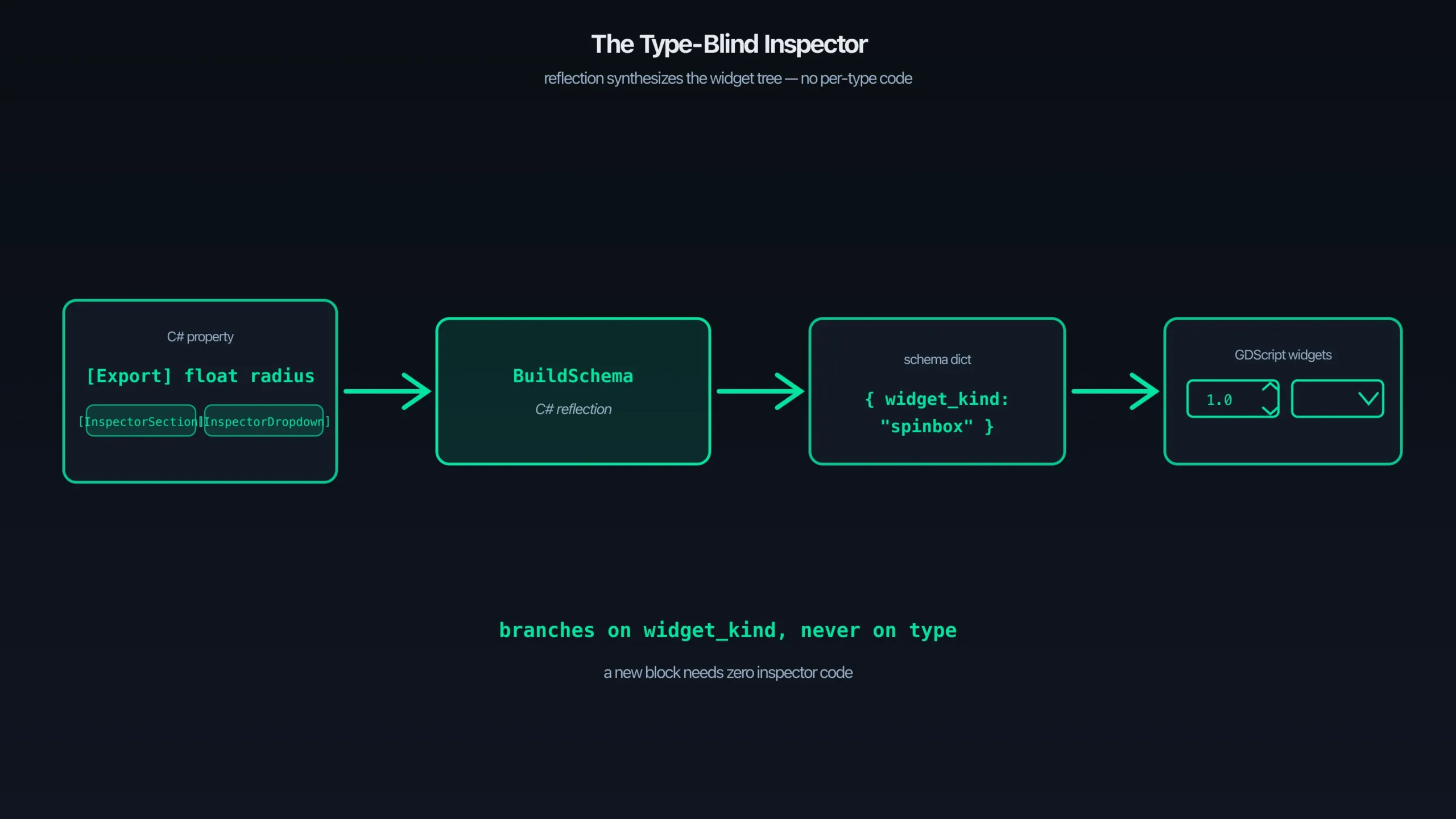
Figure 3: A C# export property carrying inspector attributes flows through reflection into a widget_kind dictionary, which the GDScript renderer turns into concrete widgets. The renderer branches on widget_kind, never on the block's type — which is why a new block needs zero inspector code.
This started life as a static INSPECTABLE_SCHEMA Dictionary hand-declared in GDScript, and was ported into typed C# attribute annotations — the citations in InspectorAttributes.cs trace the lineage explicitly. A reflection-driven framework, tightened over time.
The Shell and the Core
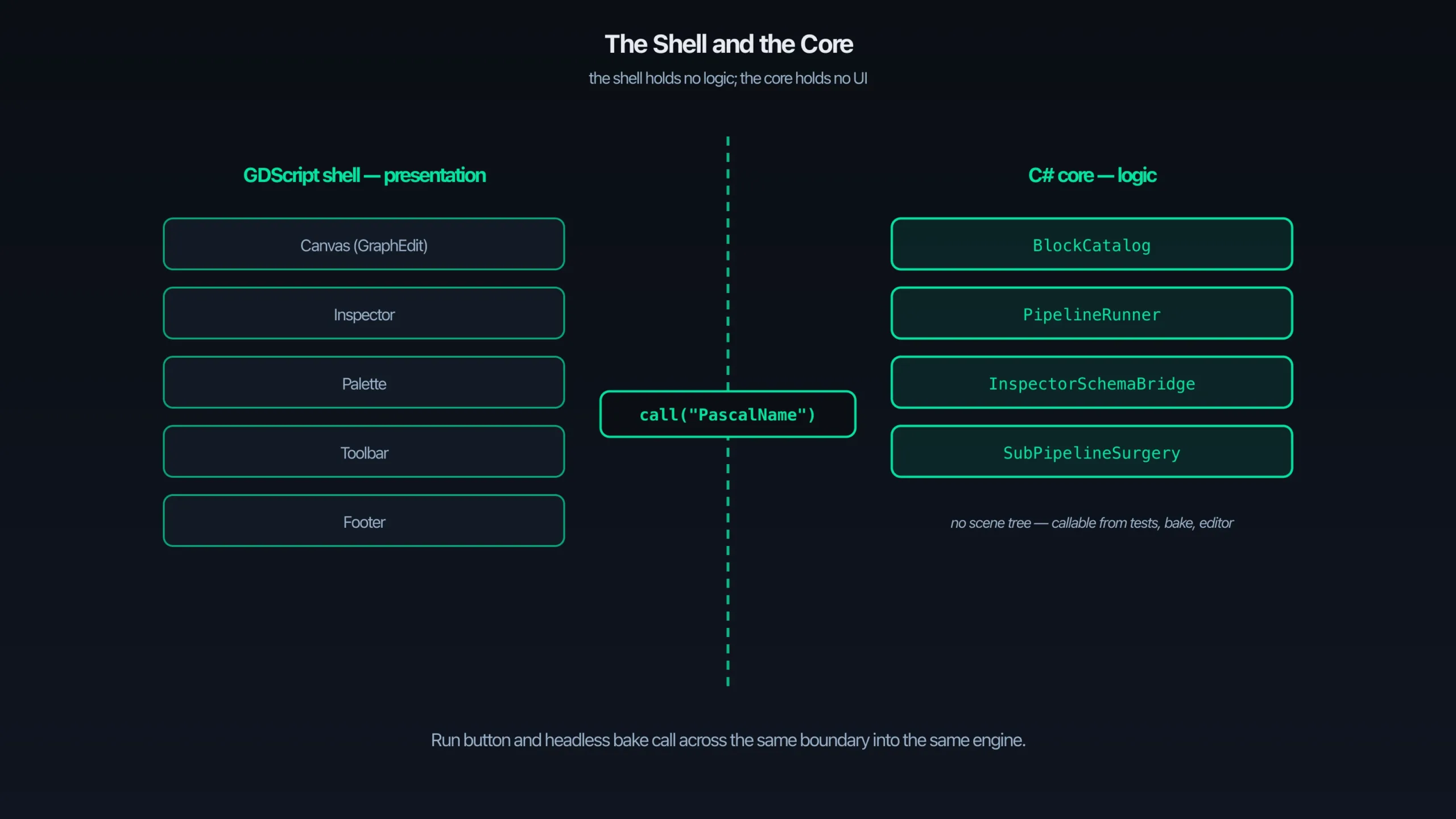
Figure 4: Presentation on the left, logic on the right, an explicit reflection boundary between them. The GDScript shell holds no logic; the C# core holds no UI and no scene tree. The Run button in the editor and the headless bake script call across the same boundary into the same engine.
What I Noticed
"The editor is the compiler" is not a metaphor I imposed on the code. It is the architecture: a graph of typed transformations, a headless scene-tree-free execution core, a build artifact committed to git, the same core running in CI, editor, and game.
I have seen this shape before. It is the orchestrator's own graph designer — the NodeTypeRegistry, pipeline-graph.schema.json, the typed directed graph the macroplatform aff-core spine is built on. The games team built a node-graph compiler for terrain and creatures. The framework built one for SDLC pipelines. Neither cited the other. The instinct — model the domain as a typed graph, separate the execution engine from the presentation, make the engine runnable headless — showed up twice, independently, in the same workspace. That is the thread DL-023 started: the conventions traveled even where the framework's heavy machinery was set aside.
The honest note: the macro_world World tab and the Dashboard tab are less complete than the Pipeline tab. The bake pipeline and the alien procgen pipeline are the polished showcases; the full city-gen dashboard is not. I am writing about the part that works.
By the Numbers
| Metric | Value |
|---|---|
| Editor type | Godot 4 @tool EditorPlugin (adds a "Pipeline" main-screen tab) |
| UI / logic split | GDScript shell (all UI) over C# core (all logic) |
| Palette blocks (self-test floor) | ≥ 40 |
| Bake graph size | 11 blocks |
| UI nesting depth | 3 — a 3D viewport inside a 2D node inside the editor |
Execution contexts sharing one RunGraph |
3 — editor Run, headless CI bake, in-game |
| Self-test exit code | equals the number of failures (CI-gateable) |
| Cross-language interop | call("PascalName") reflection, every point explicit |
Tomorrow
DL-025 is the other half of the same observation. The editor compiles content; the progression DAG governs how that content unlocks. Both are graphs. Both are the framework's instinct showing up in a game that set the framework aside. The editor was the compiler; next, progression turns out to be a graph, not a list.
Latest Entries

From Single Project to Starter Kit: Extracting a Governed Framework
From Single Project to Starter Kit: Extracting a Governed Framework The hardest part of open-sourcing an internal framework is separating the generic from the specific. [...]

DL-025: Progression Is a Graph, Not a List
DL-025: Progression Is a Graph, Not a List Most games store progression as a list — level 1, level 2, level 3. This one stores [...]
DL-024: The Editor Is the Compiler
DL-024: The Editor Is the Compiler A node graph you wire on a canvas, then press Run and watch the output render live inside the [...]

DL-023: The Same Algorithm Made Three Different Things
DL-023: The Same Algorithm Made Three Different Things A 2007 Eurographics paper on growing trees. A 1964 Japanese paper on water transport in plant stems. [...]
DL-021 Part 2: The Rule That Caught Itself
DL-021 Part 2: The Rule That Caught Itself Everything went wrong, all at once, and every single failure was the pipeline catching itself doing the [...]
DL-021 Part 1: The Content Engine
DL-021 Part 1: The Content Engine We set out to publish yesterday's devlog. The website caught a compliance gap, the wrong fix took the site [...]