
The Immutability Illusion: Why Your Compliance Toolchain Cannot Guarantee What It Promises
In our first post, we introduced the Agentic Flow Framework and its four-layer pipeline. We mentioned, almost in passing, that the framework stores everything in git — requirements, specifications, change requests, violation reports, architectural decisions. Today we explain why. Not as a convenience choice, but as a structural argument about what compliance actually requires and why the industry's standard answer fails to provide it.
Here is a question worth asking: when your auditor examines a requirement in Jira, can they independently verify — without trusting Atlassian — that the record has not been altered since it was created?
If you work in a regulated industry — medical devices under FDA 21 CFR Part 11, automotive software under ISO 26262, aviation under DO-178C, or any organization pursuing SOC 2 or ISO 27001 — the answer matters. And the honest answer is no. The auditor is trusting the vendor's infrastructure, the vendor's access controls, and the vendor's continued solvency. That is not verification. That is faith.
What Compliance Actually Requires
Compliance frameworks use different terminology but converge on the same core properties for development records:
- Immutability. Records cannot be altered after the fact without detection.
- Traceability. Every artifact links back to a requirement and forward to a test.
- Attribution. Every change has a verifiable author and timestamp.
- Accessibility. Records must be retrievable for the full retention period — often 10-15 years.
- Independence. Verification must not depend solely on the system being verified.
These are not exotic requirements. They are table stakes for any regulated development process. The EU AI Act (Regulation 2024/1689), which takes effect in 2026, adds further requirements specifically for AI systems: Article 9 mandates risk management with documented processes, and Article 14 requires human oversight with the ability to intervene.
The question is not whether these properties matter. The question is whether the tools we use to achieve them actually deliver.
The Standard Architecture and Its Structural Flaw
A typical "compliant" development process looks like this:
Requirement (Jira) → Design (Confluence) → Code (GitHub) → Test (TestRail)
    → Approval (Jira workflow) → Deploy (Jenkins) → Audit (spreadsheet)
Each arrow is a trust boundary. Each tool is a dependency. The compliance story is a chain of claims: "Jira holds our requirements, Confluence holds our specs, GitHub holds our code, and the links between them prove traceability." Auditors accept this because it is what everyone presents.
But what are these tools actually guaranteeing?
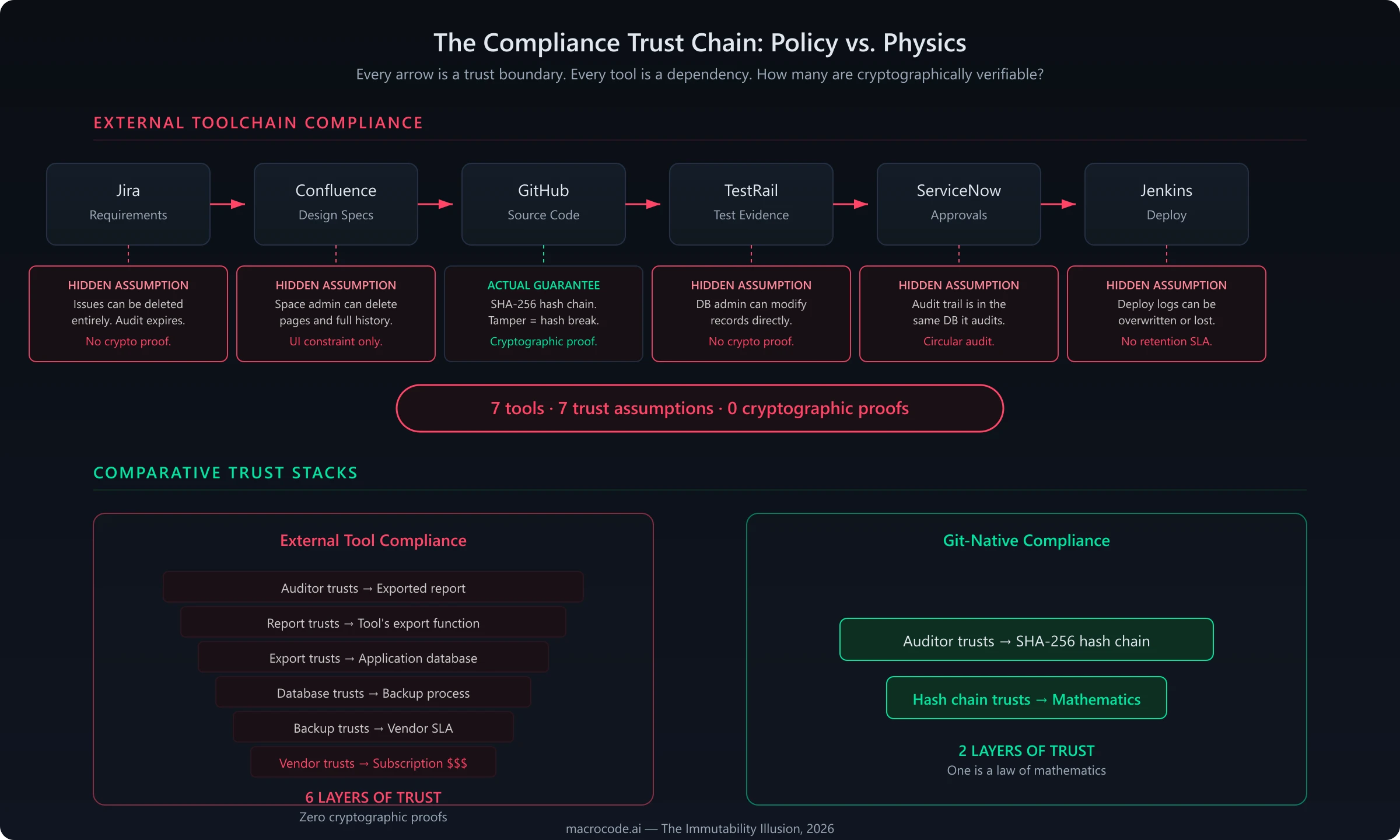 A typical compliance toolchain with its hidden trust assumptions at each boundary. Each tool provides policy-based guarantees, not cryptographic ones.
Let us be precise about what these tools guarantee and what they do not.
Jira Cloud deserves credit where it is due: its issue changelog is practically immutable from the customer's perspective. There is no UI mechanism and no REST API endpoint to edit or delete individual changelog entries. Every field change generates a changelog record, and customers cannot suppress this. This is good design.
But "practically immutable from the customer's perspective" is not the same as "immutable." The guarantee has boundaries:
- Entire issues can be deleted by project admins, destroying all changelog entries permanently. There is no "soft delete" that preserves history — deletion is total.
- Audit log retention is time-limited. According to Atlassian's documentation, the organization audit log retains entries for 180 days on Free and Standard plans. Premium extends to one year. Only Enterprise retains "indefinitely" — meaning for the duration of the contract.
- No independent verification exists. The changelog's integrity depends on Atlassian's infrastructure. Customers cannot cryptographically verify that records have not been altered at the infrastructure level. Atlassian's SOC 2 Type II certification provides assurance that internal controls exist, but SOC 2 is an audit of controls, not a cryptographic proof of data integrity.
- Atlassian operates a Shared Responsibility Model. They guarantee platform security and availability. Data integrity, backup, and recoverability are explicitly the customer's responsibility.
For Jira Server and Data Center (self-hosted), the picture is different and more concerning. Change history is stored in changegroup and changeitem database tables, documented by Atlassian. A database administrator can INSERT, UPDATE, or DELETE rows in these tables directly, bypassing all application-level audit logging. No application-level mechanism detects this.
Confluence has version history, but any space admin can delete pages — including their entire history. The "read-only" permission is a UI constraint, not a cryptographic one. Export formats (PDF, HTML) are snapshots that no external party can independently authenticate.
ServiceNow's Change Advisory Board approvals are workflow state transitions in a database. The audit trail is a table in the same database. It audits itself. This is architecturally circular.
The pattern generalizes. The structural flaw is not that these tools are poorly built — several, like Jira Cloud's changelog, are thoughtfully designed. The flaw is in the nature of the guarantee:
| What compliance requires | What tools actually provide |
|---|---|
| Cryptographic proof that records cannot be altered | Application-level design decisions that choose not to expose editing (but are not cryptographically enforced) |
| Unconditional access for the product's lifetime | Access contingent on active subscription and vendor solvency |
| Independent third-party verification | Vendor-certified audits (SOC 2) that attest to controls, not to individual record integrity |
| Complete capture of every decision | Whatever the application layer records — invisible to infrastructure-level changes |
This is not a criticism of these tools. They are excellent at what they do — project management, documentation, change tracking. The flaw is in using them as compliance primitives. They provide policy-based immutability (application-level design choices and contractual obligations) when compliance requires structural immutability (guarantees that hold regardless of who has infrastructure access).
Six Ways the Guarantee Breaks
The gap between application-level design and structural immutability manifests in concrete failure scenarios. None of these are hypothetical.
1. Vendor Migration
Your company uses Jira Cloud for all requirement traceability. You decide to switch to Linear. Your compliance officer asks: "Where are the original requirements for version 2.3, including all approval timestamps and state transitions?"
The answer: in a Jira export (CSV or JSON) that lost part of its metadata, in a format no auditor can independently verify, produced by an export tool that Atlassian can change or deprecate at any time. Under FDA 21 CFR Part 11, electronic records must be "readily retrievable throughout the records retention period." A vendor migration that degrades record fidelity is a compliance risk.
2. Subscription Lapse
A startup hits a cash crunch and pauses its Atlassian subscription for 60 days. During this period, a security incident triggers a regulatory audit.
The entire traceability chain is inaccessible. Not destroyed — inaccessible. The company cannot demonstrate compliance because its compliance evidence is behind a paywall it temporarily cannot afford. Atlassian's data retention policy provides a grace period after expiry, but the timeline and terms have changed over time and vary by product and plan tier.
3. Issue Deletion
A project administrator deletes a Jira issue — perhaps to remove a duplicate, perhaps to clean up a test issue, perhaps under pressure to remove evidence of a known defect that was deprioritized. In Jira Cloud, issue deletion is permanent and total. The issue, its changelog, its comments, and its attachments are gone. The audit log records that a deletion occurred, but the audit log entry itself expires after 180 days (or one year on Premium).
In a git-based system, deletion is a commit that removes a file. The file's entire history remains in every clone. You can delete the current version, but you cannot erase the fact that it existed.
4. Infrastructure-Level Access
This is the structural argument that applies regardless of how well the application layer is designed.
For Jira Server/Data Center: a database administrator can directly modify the changegroup and changeitem tables, as documented by Atlassian. No application-level audit log captures direct database access.
For Jira Cloud: customers have no database access, but Atlassian's internal teams do, governed by their SOC 2 controls. The integrity guarantee ultimately rests on Atlassian's internal access controls, not on cryptographic proof. This is not a criticism of Atlassian — it is an inherent property of any system where the data custodian and the data owner are different entities. Research by Verizon's Data Breach Investigations Report consistently identifies privileged access abuse as a significant attack vector.
5. Vendor-Side Data Loss
Your SaaS provider suffers a data loss incident. They restore from backup, but the backup is 48 hours old. Two days of requirement changes, approvals, and status transitions are gone.
Your compliance record now has a 48-hour gap that you cannot reconstruct. The vendor's SLA covers "availability" — typically 99.9% uptime — but says nothing about "regulatory evidence preservation." These are different guarantees, and compliance frameworks do not accept one as a substitute for the other.
6. Tool Discontinuation
Atlassian has discontinued HipChat (2018), Stride (2018), and Bitbucket Server (end of support 2024). If your compliance records lived in any of these products, you had a migration window. After that window, the records exist only in whatever export format you managed to produce. The chain of custody is broken. The export cannot prove it was not modified after extraction.
This is not unique to Atlassian. Any vendor can discontinue any product. Building compliance on a vendor's product roadmap is building on sand.
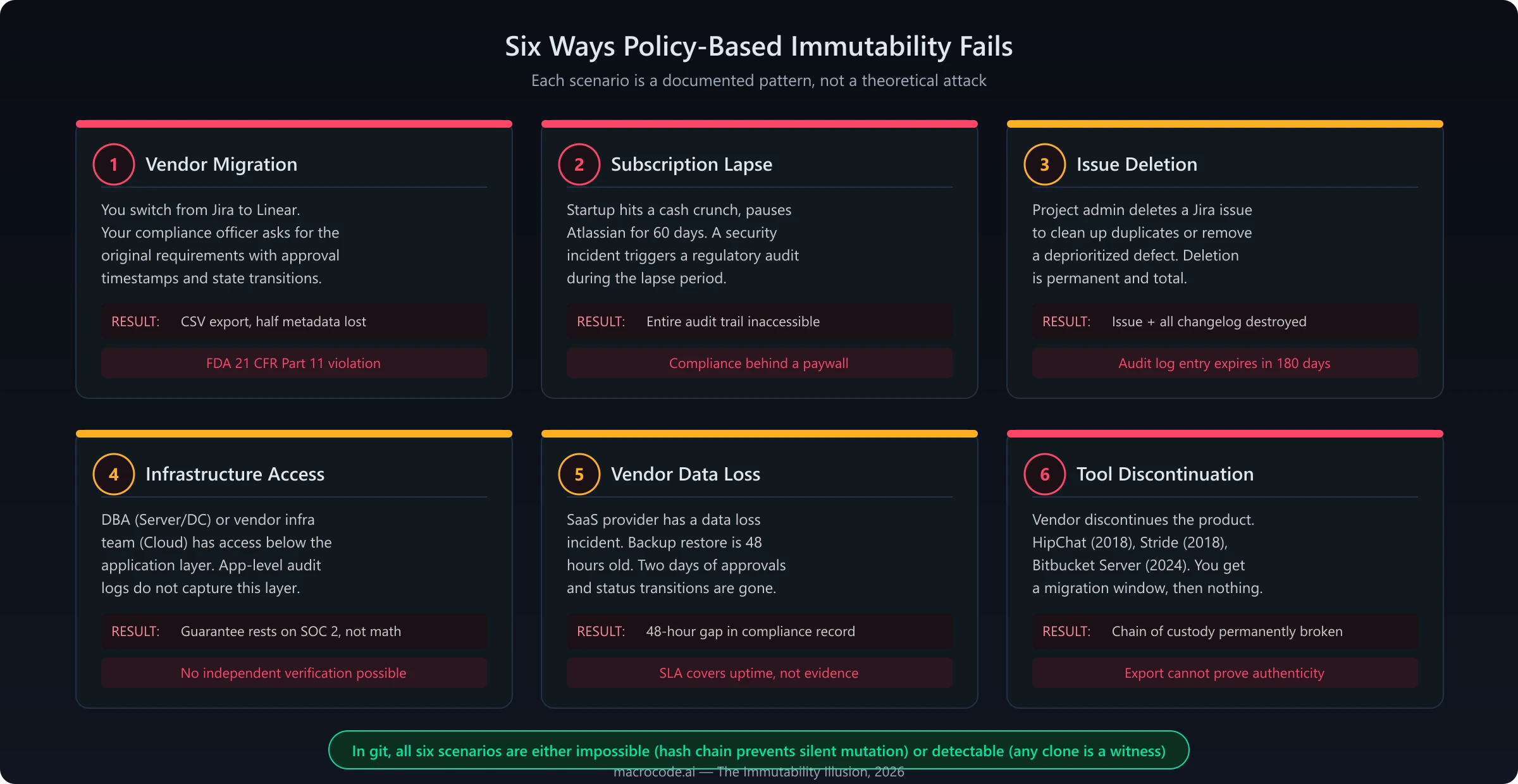 Six scenarios where the gap between application-level design and structural immutability becomes visible. Each represents a documented pattern.
Git as a Compliance Primitive
Git provides something no external tool does: content-addressable, cryptographically-linked, distributed immutability.
This is not git as a "code repository." This is git as an integrity protocol. Linus Torvalds designed git after the Linux kernel project lost access to its previous version control system (BitKeeper) — a vendor dependency problem that directly motivated git's design as a distributed, vendor-independent protocol. The properties that make it work for source code make it work for any content that requires tamper-evident history.
How git immutability works
Every object in git is identified by a cryptographic hash of its content. Git historically uses SHA-1; SHA-256 support was introduced in Git 2.29 (2020) and is available but not yet the default. SHA-1 has known collision attacks (SHAttered, 2017), which is why git is transitioning — and why we recommend SHA-256 repositories or, at minimum, GPG-signed commits for compliance use cases. Commits form a chain where each commit's hash incorporates its parent's hash. This creates a Merkle tree — the same data structure that underpins blockchain integrity.
commit abc123 (SHA-256 of: tree hash + parent hash + author + message)
  └── tree def456 (SHA-256 of: blob hashes + file names)
       ├── blob 789aaa (SHA-256 of: requirement spec content)
       └── blob 789bbb (SHA-256 of: approval record content)
To silently alter a requirement spec, an attacker would need to:
- Create a new blob with modified content (new hash)
- Create a new tree referencing the new blob (new hash)
- Create a new commit referencing the new tree (new hash)
- Rewrite every subsequent commit in the chain (all hashes change)
- Force every clone, mirror, fork, and CI cache to accept the rewritten history
Step 5 is the critical difference. Every git clone is a full, independent copy of the entire history. A single developer laptop that fetched before the rewrite becomes an independent witness. This is not "we have a policy against editing." This is "editing is cryptographically visible to every copy of the repository."
Signed commits add attribution
With GPG or SSH commit signing — which GitHub, GitLab, and Bitbucket all support natively — each commit carries a cryptographic signature that proves:
- Who made the change (tied to a cryptographic key, not a login session)
- When (timestamp in the signed payload)
- What (exact content, identified by hash)
- Integrity (any modification invalidates the signature)
Compare this to a workflow approval in any project management tool: a database row that says "user X clicked approve at time T." It proves that a session token associated with user X triggered a state transition. It does not cryptographically prove X's identity, and no external party can independently verify the record.
The audit trail in practice
Here is what a compliance query looks like. This is the real commit history for our BRD (Business Requirements Document) specification index — the file that tracks every business requirement across all products:
$ git log --format="%h %aI %s" --follow -- dev/ai/specs/business/_index.json

1f3ac30 2026-04-02T23:02:15+02:00 feat(aff-core): Maven scaffold + OpenAPI model generation [CR-194]
9d3f24d 2026-04-02T14:29:37+02:00 chore(aff): close CR-193 + v2 CLAUDE.md [CR-193]
b4c2666 2026-04-02T08:12:40+02:00 docs(aff): BRD + tech architecture for API layer [BI-019]
8433309 2026-04-02T07:06:34+02:00 feat(aff): artifact retention + schema standardization [CR-186]
1173bec 2026-03-27T12:47:40+01:00 feat(aff): agent-orchestrator as architect+developer [CR-100]
Every line is a commit hash (verifiable by any clone), an ISO timestamp, and a message linking to the change request that authorized the modification. An auditor can:
git show 9d3f24d— see the exact diff (what changed)git verify-commit 9d3f24d— verify the GPG signature (who changed it)- Compare against any other clone — confirm no tampering (was it altered after?)
No trust in vendors. No database access required. The auditor runs these commands on their own machine.
Where this fails: If the hosting platform deletes or suspends the repository, clones become the only copies. Git's integrity is distributed — but distribution requires that clones exist. A single-clone, single-host deployment has the same single-point-of-failure as any database. The mitigation is straightforward (multiple remotes, CI mirrors, developer laptops), but it is not automatic.
The comparison
| Property | Git | External tools |
|---|---|---|
| Trust model | Cryptographic hash chain (SHA-1, migrating to SHA-256) + GPG signatures | Application design + vendor SOC 2 controls |
| Verification | Any clone can verify independently | Auditor must trust vendor's infrastructure |
| Failure mode | Hash chain break (detectable by any copy) | Application-level guarantees, not enforced at infrastructure layer |
| Liveness requirement | None (offline-readable, any host) | Active subscription, vendor operational |
| Longevity | Open protocol, bare repo readable in 50 years | Vendor's business lifespan and product roadmap |
| Distribution | Every clone is a complete backup | Single database or vendor-controlled replicas |
What We Store in Git (and How Much Space It Takes)
We built a governed SDLC framework where every artifact lives alongside the code in a single repository: business requirements, functional domain specs, backend module specs, UI screen specs, change request plans and traces, violation reports, architectural decisions, and governance rules. The commit history is the audit trail. The hash chain is the immutability guarantee.
The first question people ask is: "Does that not make the repository enormous?"
We did the math. For a mature commercial product — 3 years of development, a 10-person team, roughly 600 change requests — the numbers look like this:
| Artifact category | Files | Average size | Total |
|---|---|---|---|
| Requirements and specifications | ~400 | 15 KB | 6 MB |
| Change request plans and traces | ~600 | 12 KB | 7.2 MB |
| Violation and audit records | ~150 | 4 KB | 0.6 MB |
| Architecture decisions | ~200 | 6 KB | 1.2 MB |
| Governance rules | ~50 | 5 KB | 0.25 MB |
| Decision logs | ~400 | 3 KB | 1.2 MB |
| Test evidence summaries | ~1,000 | 5 KB | 5 MB |
| Total | ~2,800 | ~21.4 MB |
With git's delta compression across an average of 15 revisions per file, the packed git object size for the entire traceability layer is approximately 30-50 MB. For context: that is less than a single node_modules dependency. A typical .git directory for a 3-year project already contains 100-500 MB of code history. Adding full compliance traceability increases repository size by 10-20%.
Even at enterprise scale — 10 years, 5,000 change requests, 2,000 specification files — the traceability layer stays under 200 MB in packed git objects. The space concern is a phantom.
 Full compliance traceability in git costs less than a single npm dependency. The numbers shown are for a mature 3-year commercial product with ~600 change requests.
The one legitimate edge case is binary artifacts — signed PDFs, screenshots, test result images. These do not compress well in git. The answer is to store structured data (JSON, Markdown), not rendered artifacts. A compliance report is a view over the data, not the data itself. When binary storage is truly required, Git LFS keeps pointers in the repository and objects in configurable storage — preserving the hash-chain integrity while offloading bulk.
The Trust Stack
This is the core argument, reduced to its essence.
When an auditor examines records in an external tool, they are trusting a chain of assumptions:
- The vendor's infrastructure did not corrupt data
- No one with infrastructure access modified records outside the application layer
- No backup restoration introduced inconsistencies
- The audit log itself was not tampered with — and has not expired
- The export accurately represents the database state
- The vendor's timestamp service is accurate
- The vendor will remain solvent and the subscription will remain active for the retention period
None of these are independently verifiable by the auditor. They are assumed. The compliance process is built on a stack of unverifiable assumptions about third-party systems. Some of these assumptions are backstopped by SOC 2 certifications and contractual SLAs — but a SOC 2 report is an attestation that controls exist, not a proof that any specific record is intact.
When an auditor examines git history, they verify three things:
- The hash chain is intact (computable by the auditor on their own machine)
- Signatures match known keys (verifiable by the auditor with public key infrastructure)
- Multiple clones agree (verifiable by comparing any two copies)
No trust in vendors. No assumptions about infrastructure access. The auditor can independently verify every claim with tools they control.
Seven layers of unverifiable trust versus three layers of mathematical proof. That is the structural difference between policy-based and physics-based compliance.
Objections We Have Heard
"Git is for developers, not compliance officers." Git is for content-addressable storage with cryptographic integrity. Compliance officers do not need to run git log — they need a dashboard that reads from git. That is a presentation problem, not an architecture problem. Tools like GitBook, Docusaurus, and every static site generator demonstrate that git-backed content can have any frontend.
"Our auditors require Jira exports." Your auditors require evidence of traceability. They accept Jira exports because that is what everyone provides. A git-based compliance package — with signed commits, hash-verified history, and structured requirement-to-code mappings — provides stronger evidence. Audit standards evolve when better evidence becomes available. Someone has to go first.
"Git history can be rewritten with force-push." Yes. And it is detectable by any clone that fetched before the rewrite. Force-push protection is a single setting on every major hosting platform. More importantly: a force-push changes every downstream hash, which means every mirror, every CI system, and every developer's local clone becomes a witness to the tampering. The tampering is not prevented — it is made cryptographically visible. That is the key distinction: git does not promise that no one will try to alter history, it promises that you will know if they do.
"Jira Cloud's changelog is already immutable." To Jira's credit, it is — at the application layer. There is no customer-facing mechanism to edit or delete individual changelog entries. But application-layer immutability and structural immutability are different things. Issues can still be deleted entirely. Audit logs expire. And the guarantee rests on Atlassian's infrastructure controls, not on mathematics that any party can verify. We are not arguing that Jira is poorly designed. We are arguing that no application running on a database can provide the same immutability guarantee as a content-addressed hash chain distributed across independent copies.
"Non-technical stakeholders cannot use git." They do not need to. They write in a UI that commits to git on save. This pattern is well-established — Netlify CMS (now Decap CMS), Forestry, and dozens of headless CMS tools provide rich editing experiences backed by git commits. The storage layer does not constrain the input layer.
Compliance Should Be a Property of the Repository
The software industry has accepted a compliance model where the integrity of development records depends on vendor infrastructure, active subscriptions, and application-level design decisions that are not cryptographically enforced.
This model persists because it is familiar, because vendors have sales teams and SOC 2 certifications, and because "we use Jira" is an easier answer in an audit than "we built a git-native compliance framework."
But the structural argument is clear. Git provides immutability guarantees that are mathematically verifiable by any party, at negligible marginal cost, with no vendor dependency. The compliance record should live where the code lives — in a cryptographically-linked, distributed, vendor-independent repository that any party can verify with a git clone and a hash check.
We are not arguing that you should stop using Jira for project management. Jira is a well-designed project management tool with a changelog system that is, at the application layer, more robust than most. We are arguing that project management tools and compliance systems of record are different jobs with different requirements, and conflating them creates a gap between what compliance demands and what the toolchain delivers.
In the Agentic Flow Framework, we made this choice from day one. Every requirement, every specification, every change request, every violation report, every architectural decision lives in git. The commit history is the audit trail. The hash chain is the proof. The next time an auditor asks for evidence of traceability, we will hand them a repository — and the mathematics to verify it.
Upcoming in this series:
- The Autopoietic Property — when your SDLC pipeline manages itself, and the three fixed points that prevent infinite regress
- Context Budget Engineering — fitting 164 specifications in a 1M token window with 99% context savings
- SDLC-bench — designing the first benchmark that measures process quality, not just code quality
Follow our progress at macrocode.ai/blog.
References
- U.S. Food and Drug Administration. "21 CFR Part 11 — Electronic Records; Electronic Signatures." Code of Federal Regulations, Title 21. ecfr.gov
- European Parliament (2024). "Regulation (EU) 2024/1689 — Artificial Intelligence Act." Official Journal of the European Union. eur-lex.europa.eu
- ISO/IEC (2022). "ISO/IEC 27001:2022 — Information security management systems." International Organization for Standardization. iso.org
- AICPA (2017). "SOC 2 — Trust Services Criteria." Association of International Certified Professional Accountants. aicpa-cima.com
- RTCA (2011). "DO-178C — Software Considerations in Airborne Systems and Equipment Certification." Radio Technical Commission for Aeronautics. rtca.org
- Torvalds, L. (2005). "Git — A Free and Open Source Distributed Version Control System." git-scm.com
- Merkle, R.C. (1979). "Secrecy, Authentication, and Public Key Systems." Stanford PhD Thesis. Wikipedia — Merkle tree
- Verizon (2024). "Data Breach Investigations Report." verizon.com/dbir
- Atlassian (2024). "Audit activities in your organization." support.atlassian.com
- Atlassian. "JRACLOUD-78612: Add PUT and DELETE methods for changelog entities." jira.atlassian.com
- Atlassian. "JRACLOUD-71685: Ability to remove specific information from history Tab." jira.atlassian.com
- Atlassian. "Database — Change History (Jira Server)." developer.atlassian.com
- Atlassian. "Cloud Security Shared Responsibilities." atlassian.com
- Atlassian. "SOC 2 — Atlassian Trust." atlassian.com
Co-authored with Claude Opus 4.6 — macrocode.ai
Latest Articles

Open-Sourcing the Agentic SDLC Framework: v2.0 Is Here
Open-Sourcing the Agentic SDLC Framework: v2.0 Is Here After 12 weeks of research, benchmarking, and community building — the Agentic Flow Framework goes open source. Here is everything we learned, what v2.0 includes, and how [...]

The Negative Self-Referential Tax: When Governance Overhead Becomes a Benefit
The Negative Self-Referential Tax: When Governance Overhead Becomes a Benefit Conventional wisdom says governance adds overhead. Our data shows the opposite — framework changes processed through the governed pipeline cost less than application changes. The [...]