Introducing the Agentic SDLC Framework: How AI Agents Govern Their Own Development Process
Your AI coding agent just wrote 400 lines of code. It compiled. The tests pass. Ship it?
Here is the question nobody is asking: which specification did that code implement? Who reviewed the architectural impact? Is there an audit trail linking the business requirement to the generated code to the test that validates it? If a defect surfaces in three months, can you trace it back to the agent invocation, the prompt, and the context window that produced it?
If you use Cursor, Copilot, Devin, or any multi-agent framework like CrewAI or AutoGen, the honest answer is: no. The industry solved code generation. It has not solved governed code generation.
We built a system that solves it. The Agentic Flow Framework is a governed, self-referential multi-agent SDLC pipeline where 12 specialized AI agents develop software through a four-layer specification hierarchy with formal quality gates, full process observability, and a unique property: the pipeline manages its own evolution through the same process it uses for application code.
This post introduces the framework, explains why it exists, and shares measured data from a real production system.
The Governance Gap
AI coding agents are transforming software development. GitHub reports that over 92% of developers now use AI coding tools in some capacity. Multi-agent systems like CrewAI and Microsoft's AutoGen enable teams of specialized agents to collaborate on complex tasks. But this transformation is happening without governance.
| Problem | Impact |
|---|---|
| No specification traceability | AI-generated code has no formal link to requirements. "Why was this code written?" has no auditable answer. |
| No quality gates | Agents produce code without architecture review, spec consistency checks, or pipeline validation. |
| No process observability | Teams cannot answer: "Which agent wrote this? How many tokens did it cost? Did it follow our standards?" |
| No agent accountability | When agent-generated code has defects, there is no trace back to which agent, which prompt, which context. |
| No self-governance | The tools that manage AI development are themselves ungoverned — updated ad-hoc, with no change management. |
| No empirical evidence | The industry has no benchmarks for governed agentic development. We measure accuracy (SWE-bench) but not process quality. |
These are not theoretical concerns. They are the six problems we encountered building a production platform with AI agents, and they are the problems that led us to build the framework.
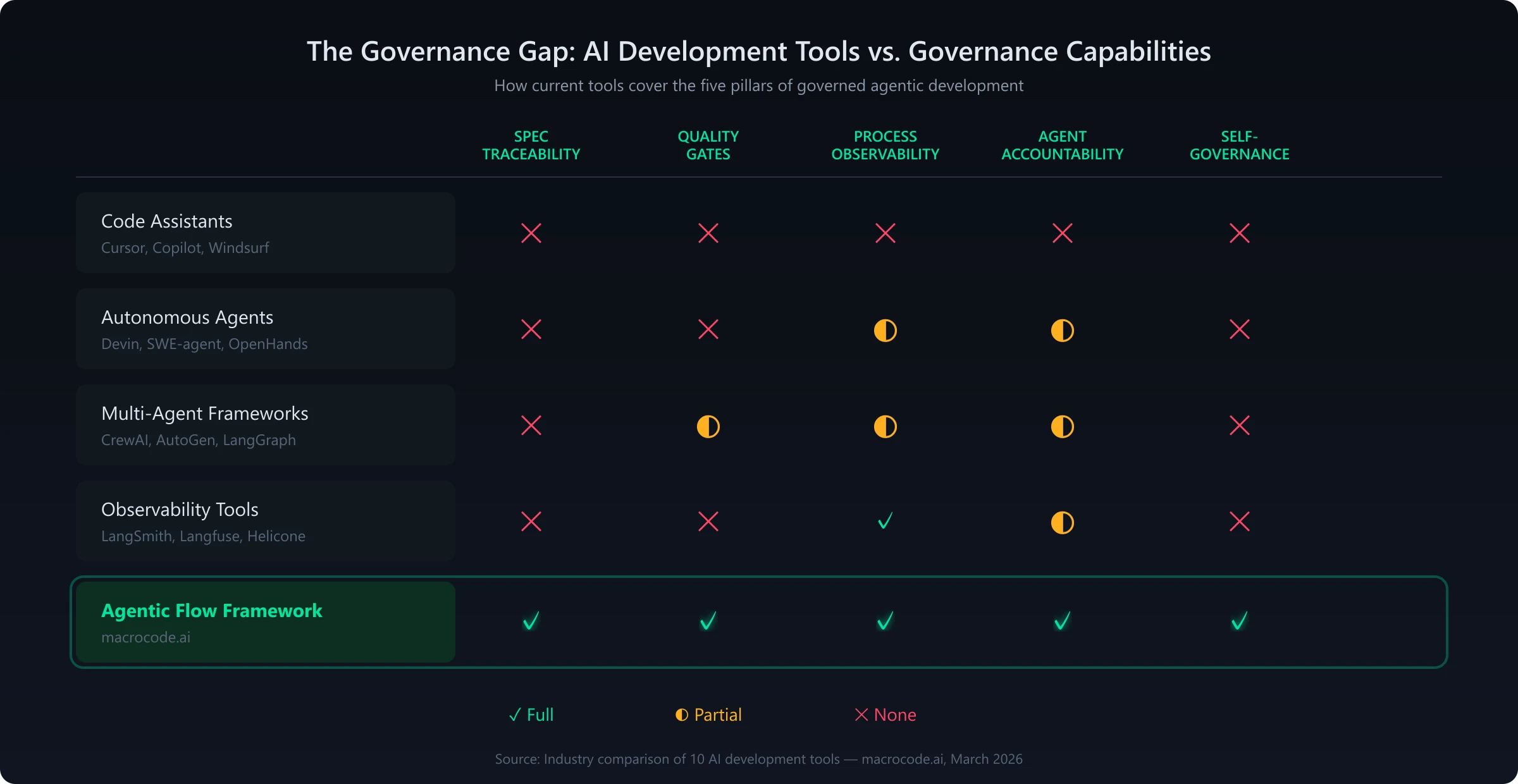 Current AI development tools excel in their domains but leave governance gaps across the full SDLC. No existing tool combines spec traceability, quality gates, process observability, agent accountability, and self-governance.
The timing is not accidental. The EU AI Act (Regulation 2024/1689) takes effect in 2026, creating mandatory traceability and human oversight requirements for AI systems — including AI used in development. Article 9 mandates risk management systems with documented processes. Article 14 requires human oversight with the ability to intervene in real time. Enterprise adoption of AI coding tools demands the same audit trail and governance that traditional SDLC provides. And to our knowledge, no academic benchmark exists for measuring governed agentic development: the field cannot improve what it cannot measure.
What Exists Today
The current landscape of AI development tools falls into four categories. Each is strong in its domain. None provides governance across the full SDLC.
Code Assistants (Cursor, GitHub Copilot, Windsurf) excel at autocomplete, single-file edits, and IDE integration. They are the most widely adopted tools. What is missing: they have no pipeline, no specifications, no quality gates, and no multi-agent coordination. They generate code at the statement level, not the system level.
Autonomous Agents (Devin, SWE-agent, OpenHands) aim for end-to-end task completion with autonomous execution. They can resolve GitHub issues and implement features with minimal human intervention. What is missing: governance, traceability, and human approval gates. Autonomy is the goal, not governed autonomy.
Multi-Agent Frameworks (CrewAI, AutoGen, LangGraph) provide agent orchestration, role specialization, and state machines for coordinating multiple AI agents. They are the closest architectural cousins to what we built. What is missing: SDLC-specific governance, spec-driven development, and self-reference. They are general-purpose coordination tools, not software engineering process systems.
Observability Tools (LangSmith, Langfuse, Helicone) are excellent at LLM call tracing and token cost tracking. They answer "what did the model do?" at the API call level. What is missing: SDLC-level traceability. They cannot answer "which business requirement drove this code change?" because they observe LLM calls, not the development process.
The gap is clear. No system combines all five: multi-agent SDLC coordination, spec-driven development, quality gates, process observability, and self-governance. An industry comparison of 10 tools that we conducted confirms this — ours is the only system where self-governance and spec-driven development coexist. Building self-governance requires the system to be mature enough to manage itself — a chicken-and-egg problem that only resolves through iterative development. Building spec-driven development requires domain-specific spec schemas — a commitment to SDLC specificity that general-purpose frameworks avoid. That gap is what the Agentic Flow Framework fills.
What the Agentic Flow Framework Is
The Agentic Flow Framework is the governance layer for AI-driven software development — where every agent is accountable, every change is traceable, and the pipeline improves itself.
The framework is a governed multi-agent SDLC pipeline built on three architectural commitments.
A four-layer pipeline
Every change flows through Business, Architecture, Implementation, and Verification layers, in that order. Each layer transition is a formal quality gate requiring human approval. A business requirement cannot reach implementation without passing through architecture. Implementation cannot ship without verification. There are no shortcuts.
This is not a novel idea — it is a formalization of what the CMMI Institute has advocated for decades in traditional software development, now applied to AI-driven development for the first time. The insight is that AI agents need more process discipline than human developers, not less, because their failure modes are different: they fail silently, confidently, and at scale.
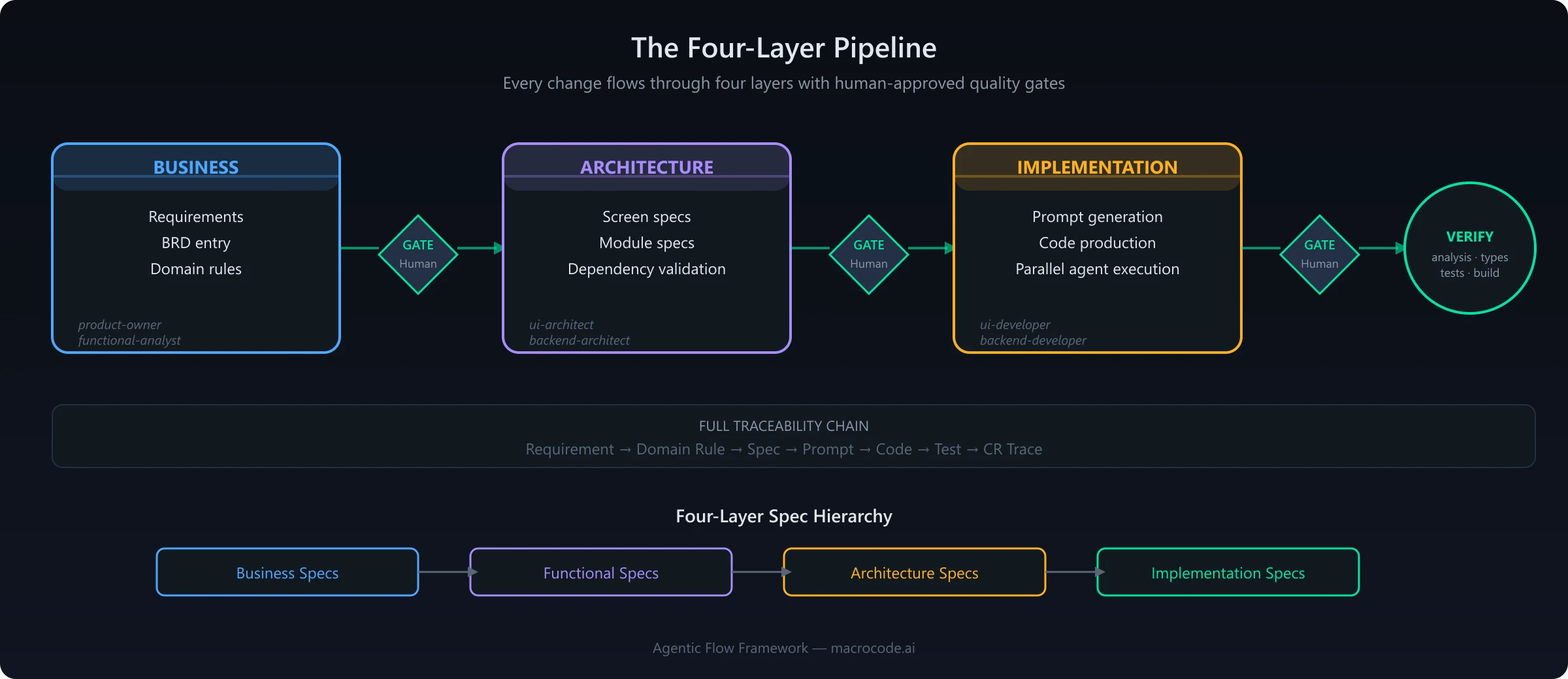 Every change request flows through four layers with human-approved quality gates between each transition. No shortcut paths exist — the pipeline enforces sequential layer progression.
12 specialized agents with bounded contexts
There is no single "god-agent" that tries to do everything. A functional analyst agent transforms business requirements into formal domain specifications. A UI architect agent defines screen layouts and component structures. A backend developer agent implements code per module spec. Each agent has a defined role, a bounded file scope, and a token budget. The orchestrator routes; agents execute. No agent knows the full system.
This design draws from the bounded context principle articulated by Eric Evans in Domain-Driven Design (2003) and popularized by Martin Fowler: each agent owns a bounded domain and communicates through well-defined interfaces — specs and prompts — not shared state.
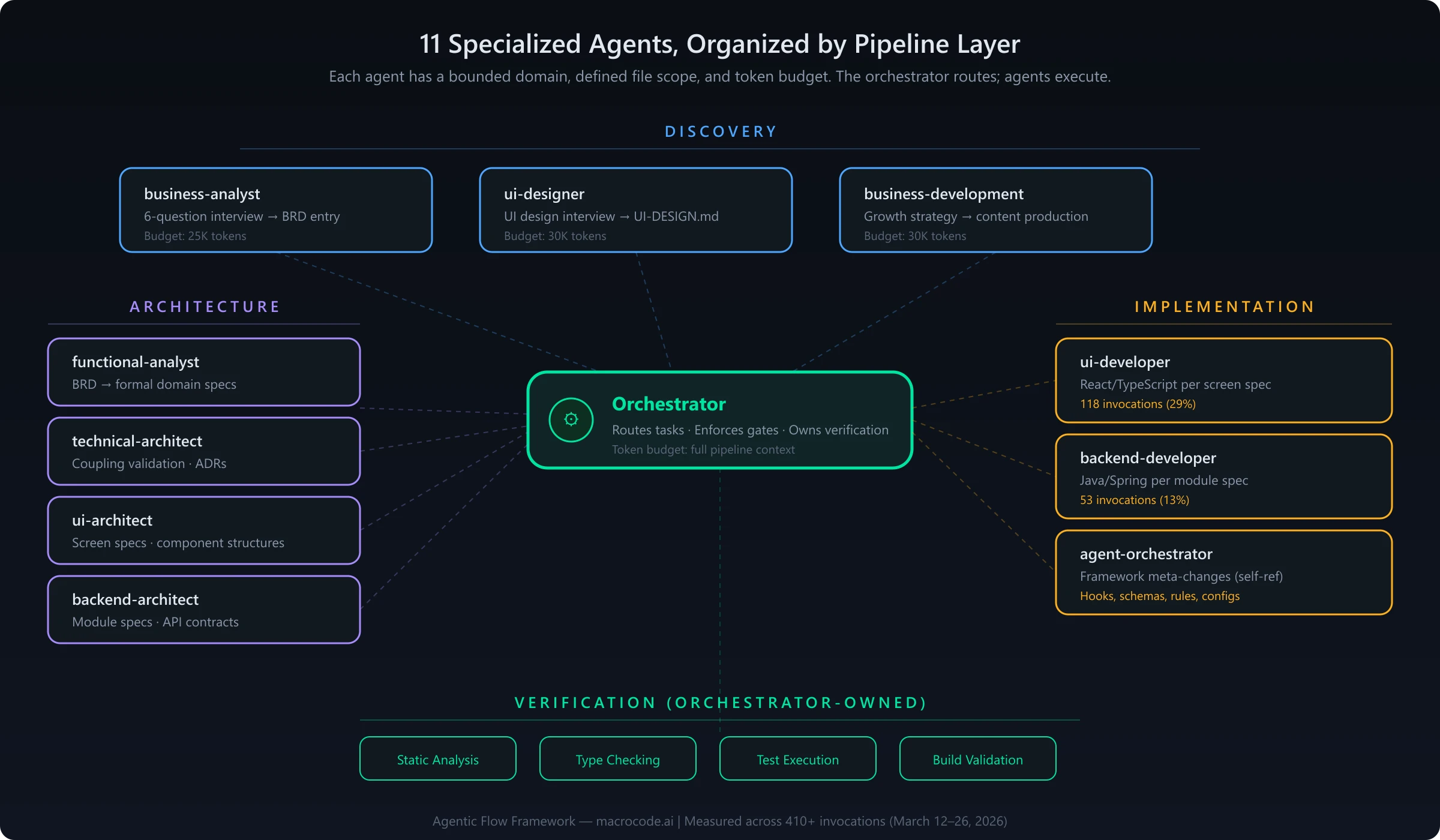 12 specialized agents organized by pipeline layer. The orchestrator routes tasks to agents based on the current pipeline phase. Each agent has bounded file scope and a token budget.
Spec-driven development
Agents read specifications before writing code. A four-layer spec hierarchy — Business, Functional, Architecture, Implementation — ensures every line of code connects to a requirement. A spec that no agent reads is a spec that should be deleted. The specs are consumed, not ceremonial.
Here is a concrete example. When a new business requirement arrives:
- The product owner agent conducts a structured interview and produces a Business Requirements Document entry
- The functional analyst maps the requirement to formal domain rules
- The UI architect and backend architect translate domain rules into screen specs and module specs
- The orchestrator generates implementation prompts from those specs
- The UI developer and backend developer implement code per their respective specs
- The orchestrator runs automated verification: static analysis, type checking, test execution, and build validation
- Every artifact is linked: requirement → spec → code → test → change request trace
Every step is logged. Every agent invocation is recorded with its prompt, context window, and output. Every gate transition is auditable.
Here is what this looks like for a real change request — CR-156, adding a product catalog screen to the AI Sales product:
$ git log --oneline --grep="CR-156"
a3f1e2c feat(ai-sales): product catalog screen + CRUD operations [CR-156]
8b2d4f1 chore(ai-sales): CR-156 plan — 3 tasks, 2 agents [CR-156]
// The CR plan — what the orchestrator produces before any agent is spawned
{
  "crId": "CR-2026-03-28-156",
  "vertical": "ai-sales",
  "tasks": [
    {
      "id": "T-01",
      "agent": "ui-developer",
      "description": "Implement ProductCatalog screen per screen spec",
      "promptContext": {
        "targetSpecs": ["dev/ai/specs/ai-sales/ui/screens/product-catalog.json"],
        "requiredTechSkills": ["react-testing"]
      }
    }
  ]
}
The plan references spec files by path. The prompt generator reads those paths, loads the content at the appropriate summarization level, and produces a prompt file. The agent receives the prompt and starts coding — it never navigates the knowledge base.
Where this fails: The plan is only as good as the orchestrator's understanding of which specs are affected. If the orchestrator misidentifies the affected screens or modules, the agent receives an incomplete or wrong context. This happened during CR-152 (workspace isolation) when the plan omitted a cross-cutting dependency. The agent produced correct code for its spec — but the spec was incomplete.
The Self-Referential Property
The most distinctive property of the framework is that it governs itself through its own pipeline.
When the framework needs a new agent, a new quality gate, or a new schema, that change goes through the same Business → Architecture → Implementation → Verification pipeline as any application feature. A framework change request is processed by the same orchestrator, validated against the same schemas, and logged in the same trace system. A dedicated framework agent — whose domain is the governance system itself — implements framework changes the same way the backend developer agent implements application code.
Biologists Humberto Maturana and Francisco Varela coined the term autopoiesis in 1972 to describe systems that produce and maintain themselves — systems whose organization is defined by their own internal processes rather than external inputs. The Agentic Flow Framework exhibits this property: it is a development process that develops itself. This is not just an elegant property. It is the strongest possible validation of the governance model — if the governance breaks when applied to the governance system, the governance is broken.
Over 14 days of formal operation (March 12–26, 2026), the framework processed 18+ framework change requests through its own pipeline, tracked via structured activity logs. The empirical evidence shows something counter-intuitive: framework changes cost less than application changes. The governance overhead for self-referential changes is negative — governance applied to governance costs less, not more, because framework specifications are simpler and more standardized than application specifications.
The self-reference is bounded by three fixed points that the framework cannot modify:
- Git history — Immutable, append-only audit trail. The framework cannot rewrite its own history.
- Structural schemas — Formal invariants that constrain what the framework can express. Schema changes require human approval.
- The human — Intent alignment gate. The human approves every layer transition. This gate must never be automated away.
These three invariants prevent infinite self-reference from becoming circular. They are design principles, not limitations.
What We Have Measured
These are not projections. This is measured data from a production system, collected over 14 days of formal operation (March 12–26, 2026). All metrics are derived from structured agent activity logs and change request trace records.
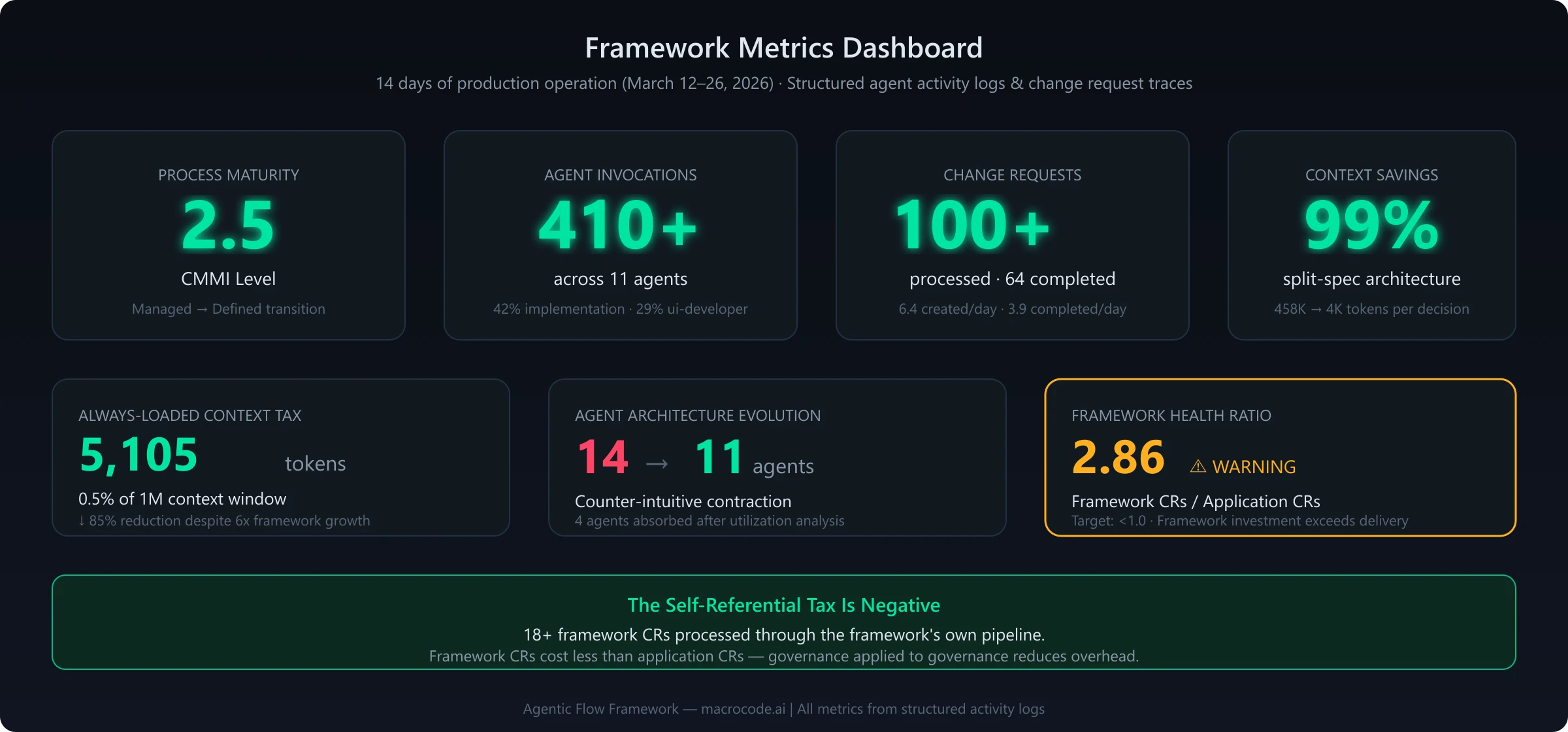 Key metrics from 14 days of production operation. All numbers are derived from structured agent activity logs and change request traces.
CMMI self-assessment: ~2.5. We self-assessed the framework against the CMMI V2.0 model. This is not a formal appraisal — CMMI certification requires a licensed lead appraiser, and we have not undergone one. Our self-score places the framework at the transition between Level 2 (Managed) and Level 3 (Defined): gate enforcement, schema validation, and agent specialization are defined processes, but organization-wide standardization is still emerging. We include this number for positioning context, not as a certified claim.
730+ agent invocations across 12 agents. The UI implementation agent accounts for 118 invocations (29%), the backend implementation agent for 53 (13%), and the remaining 9 agents fill architecture, analysis, and governance roles. Implementation agents dominate at 42% of all invocations — expected, since implementation is the most labor-intensive pipeline phase.
196 CRs processed, 126 completed (as of 2026-04-04, over 24 days of operation since March 12). Every CR has a full lifecycle trace: created → planned → in-progress → verified → done.
99% context savings from split-spec architecture. Without the four-layer split-spec architecture, the orchestrator would need to load approximately 458K tokens of spec context per routing decision. With the split architecture, the load drops to approximately 4K tokens — a 99% reduction. For individual agents, the savings are 84%, from approximately 50K tokens down to 8K per invocation. These numbers come from measuring the total token count of all spec files versus the subset each agent actually loads.
5,105 tokens always-loaded context tax. The framework's governance overhead — the rules, agent profiles, and configuration that every conversation must carry — consumes 0.5% of the 1M context window. Despite a 6x increase in total framework size during the assessment period, the always-loaded tax decreased by 85% through architectural patterns including commit-time meta-validation, pre-computed context assembly, and hierarchical summarization. We will detail these patterns in an upcoming post on context budget engineering.
The framework also demonstrates data-driven self-correction. The agent architecture underwent a counter-intuitive contraction from 14 agents to 12 during the assessment period, despite growing in every other dimension. Four agents were deprecated after utilization analysis revealed their roles could be absorbed by the orchestrator — a real-world instance of what Conway's Law predicts in reverse: the communication structure optimized itself to match the actual work topology.
We are honest about the limitations. The Framework Health Ratio measures how much application value the framework produces per unit of framework investment:
FHR = Application CRs completed / Framework CRs required (per unit time)
| FHR Range | State | Meaning |
|---|---|---|
| > 10 | Healthy | Framework is a force multiplier |
| 5–10 | Monitor | Overhead noticeable |
| 2–5 | Warning | Significant capacity consumed by framework |
| < 2 | Critical | Framework consuming more than it produces |
Our FHR stands at 2.86 — Warning zone. For every framework CR, we complete 2.86 application CRs. That is expected during bootstrap: the framework is itself a product (promoted to product tier on 2026-04-01), so ~40% of "framework CRs" are product development — schemas, APIs, enforcement hooks, the Java core. As the framework stabilizes, FHR should climb toward Monitor. It hasn't yet.
Planning rate over time. During the first two weeks (March 12–26), only 16% of CRs had formal plans — the planning gate did not exist yet. The planned-to-in_progress gate was introduced in week 3. After enforcement, every CR that enters implementation has a plan. The 16% number is a snapshot of the pre-enforcement period, not the current state. This is the trajectory of a prototype: measure, discover the gap, enforce, measure again.
Measurement and analysis capabilities remain immature — data is collected but not yet systematically analyzed. These gaps are documented and tracked, not hidden.
What Is Next
The framework is pursuing a dual-track strategy: research and open source.
Research track. We are building SDLC-bench, a novel benchmark for governed agentic development with 7 scoring dimensions and a 20-task corpus. SWE-bench (Jimenez et al., 2023) measures whether agents can fix bugs; SDLC-bench will measure whether agents can follow a governed process while fixing bugs. An ablation study will quantify which governance components contribute most to code quality. The target: an arXiv preprint and submission to ICSE 2027 or FSE 2027.
Open source track. The framework will be extracted into a repo-agnostic starter kit and published under Apache 2.0 on GitHub. The goal: any team can adopt governed agentic development without starting from zero.
Upcoming in this series:
- The Immutability Illusion — why your compliance toolchain cannot guarantee what it promises, and why git-native traceability is the structurally correct answer
- The Autopoietic Property — a deep dive into self-referential software development and what happens when a pipeline governs itself
- Context Budget Engineering — how we manage the 1M token window as a finite, budgetable resource with 99% savings
We are sharing this journey publicly because the findings are too significant to keep internal. Governed agentic development is a new engineering discipline, and it needs transparent, evidence-based research to mature. The data is real. The limitations are documented. The methodology is reproducible.
If you are building with AI agents and struggling with traceability, quality, or process discipline, you are not alone. The governance gap is an industry-wide problem, and it requires industry-wide collaboration to solve.
Follow our progress at macrocode.ai/blog. The framework will be open-sourced under Apache 2.0 — watch for announcements.
References
- Jimenez, C.E., et al. (2023). "SWE-bench: Can Language Models Resolve Real-World GitHub Issues?" arXiv:2310.06770
- European Parliament (2024). "Regulation (EU) 2024/1689 — Artificial Intelligence Act." Official Journal of the European Union
- CMMI Institute. "CMMI V2.0 Model." cmmiinstitute.com
- Maturana, H.R. & Varela, F.J. (1972). "Autopoiesis and Cognition: The Realization of the Living." D. Reidel Publishing
- Evans, E. (2003). "Domain-Driven Design: Tackling Complexity in the Heart of Software." Addison-Wesley
- Conway, M.E. (1968). "How Do Committees Invent?" Datamation
- GitHub (2024). "Survey: The AI Wave Grows." github.blog
Co-authored with Claude Opus 4.6 — macrocode.ai
Latest Articles
Open-Sourcing the Agentic SDLC Framework: v2.0 Is Here
Open-Sourcing the Agentic SDLC Framework: v2.0 Is Here After 12 weeks of research, benchmarking, and community building — the Agentic Flow Framework goes open source. Here is everything we learned, what v2.0 includes, and how [...]

The Negative Self-Referential Tax: When Governance Overhead Becomes a Benefit
The Negative Self-Referential Tax: When Governance Overhead Becomes a Benefit Conventional wisdom says governance adds overhead. Our data shows the opposite — framework changes processed through the governed pipeline cost less than application changes. The [...]